
20 Years in B2B Marketing Teaches You Many Things. Most of Them Are Uncomfortable.
Twenty years in B2B marketing teaches you many things. Most of them are uncomfortable.
Not because markets change. Not because technology evolves. And not because every few years a new platform arrives promising to reinvent how growth works.
The uncomfortable lessons come from seeing how often marketing mistakes activity for impact.
Over the years, I have watched companies invest millions into campaigns that generated attention but not opportunity. I have seen marketing teams celebrate lead volumes that never became pipeline. I have sat in leadership discussions where impressive dashboards created the appearance of progress while the business continued asking the same question quarter after quarter: where will growth come from?
This page is not about career milestones. It is about the convictions that shaped my approach to B2B marketing thought leadership after two decades of being held accountable for growth.

Most people who spend twenty years in marketing collect opinions. They develop preferences, favourite tactics, and theories about what works. A smaller group collect convictions. The difference is not experience. It is accountability.
If you spend your career being measured on activity, you learn how to explain activity. If you spend your career being measured on revenue, you learn how little activity matters when it fails to create commercial outcomes.
That distinction shaped the way I think about marketing, leadership, and growth. It became the foundation of my B2B demand generation philosophy and continues to influence every decision I make today.
The convictions on this page were not formed in workshops, conferences, or strategy sessions. They were formed through years of building demand, creating pipeline, and learning what happens when marketing is expected to contribute directly to business outcomes.
What does two decades of building pipeline actually teach you? Not what the industry says it should. What it actually does.
The Pattern I Kept Seeing
When I look back across my career, the most valuable lesson was not tied to a specific company, campaign, or stage of growth. It was a pattern that appeared again and again regardless of market conditions, team size, budget, or business model.
From my early days as an SEO Executive to later leadership roles and eventually SVP responsibilities, I kept encountering the same failure mode: marketing organised around activity rather than outcomes.
Teams were rewarded for generating leads rather than building pipeline. Success was measured through campaign performance rather than revenue contribution. Marketing departments became increasingly sophisticated at reporting what they had done, but not always at demonstrating what the business had gained as a result.
Early in my career, I believed that strong execution naturally produced strong outcomes. If content was compelling, campaigns were well managed, and channels performed efficiently, growth would follow.
Experience taught me otherwise.
During thirteen years at MarketsandMarkets, I moved through four promotions. With every step came a higher level of accountability. The higher I moved, the less people cared about activity metrics and the more they cared about business outcomes.
Nobody wanted to know how many campaigns had launched. Nobody wanted to know how many reports had been produced. Nobody wanted a detailed explanation of marketing effort.
The questions became much simpler: How much qualified pipeline did marketing create? How many opportunities entered the sales process? How effectively was marketing contributing to growth?
That shift changed everything.
The moment the conversation moved from “How many leads did we generate?” to “How much qualified pipeline did we build?” priorities changed. Decision-making improved. Marketing and sales became more aligned. Resources moved toward initiatives that created commercial impact rather than simply producing activity.
The results reinforced the lesson. Inbound SQLs grew by 350%, pipeline increased by 40% year over year, and win rates improved by 50%.
I do not mention those numbers as achievements. I mention them because they demonstrate what happens when accountability changes behaviour.
When marketing is measured against pipeline, teams focus differently. They make different decisions. They invest differently. They stop optimising for visibility and start optimising for outcomes.
That lesson became one of the foundations of my B2B pipeline thinking.
Over time, I became convinced that many marketing problems are not execution problems at all. They are accountability problems. Organisations often have talented people and capable teams. What they lack is a direct connection between marketing activity and business growth.
Marketing organised around activity creates more activity.
Marketing organised around pipeline creates growth.
Everything I believe today starts there.
The Three Convictions
1. Conviction 1: Digital Marketing Should Build Pipeline. Not Reports.
This conviction took almost a decade to fully form.
Like many marketers, I started my career believing that reporting was one of marketing’s most important responsibilities. Dashboards provided visibility. Metrics demonstrated progress. Campaign reports helped justify investment and guide decision-making.
All of those things are useful, but none of them are the objective.
The longer I worked in B2B marketing, the more I noticed a troubling pattern. Some of the teams producing the most impressive reports were creating surprisingly weak commercial outcomes.
Traffic increased. Engagement increased. Lead volumes increased.
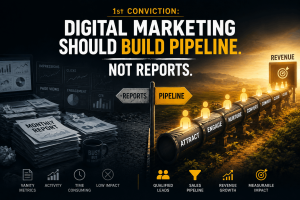
Yet the pipeline remained inconsistent. Sales teams questioned lead quality. Revenue growth failed to reflect the optimism presented in marketing reviews.
The reports were accurate. The interpretation of those reports was often the problem.
What many organizations had built was a sophisticated system for measuring activity rather than an effective system for creating demand.
That distinction matters.
Reports are evidence of activity. Pipeline is evidence of impact.
When organizations confuse the two, they create an illusion of progress. Teams become highly skilled at explaining performance without improving performance. Marketing departments spend months refining dashboards while neglecting the systems responsible for generating qualified demand.
I have seen businesses become obsessed with attribution models while struggling to create opportunities. I have seen organisations celebrate campaign metrics that had almost no connection to revenue. I have watched teams optimise for lead volume because it was easier to measure, even when those leads rarely converted into meaningful pipeline.
Eventually, a simple truth became impossible to ignore.
Every metric is a proxy. Traffic is a proxy. Engagement is a proxy. Leads are a proxy.
Pipeline is not.
Pipeline is the closest thing marketing has to a commercial outcome before revenue itself.
That is why I believe digital marketing should build pipeline, not reports.
Reports are useful because they help us understand performance. Pipeline matters because it determines business performance.
The purpose of marketing is not to prove that marketing happened. The purpose of marketing is to create opportunities that drive growth.
Everything else should support that objective.
This belief now sits at the center of my B2B demand generation philosophy. Every strategy, channel, campaign, and investment ultimately has to answer the same question:
Will this contribute to a qualified pipeline?
If the answer is unclear, the activity is probably less important than it appears.
2. Conviction 2: I Don’t Run Campaigns. I Architect Marketing Systems.
One of the most common mistakes I see in B2B marketing is the tendency to think in campaigns rather than systems.
Campaigns are attractive because they are visible. They create momentum. They provide something tangible to launch, measure, and discuss.
The problem is that campaigns are temporary.
Growth is not.
A campaign begins, runs, and ends. A system continues working long after the campaign has finished.
The longer I spent building marketing organizations, the more convinced I became that sustainable growth comes from systems rather than events.
When I look at businesses that consistently create demand, I rarely find a single campaign responsible for their success. Instead, I find interconnected systems working together over time. Content systems attract buyers, SEO systems compound visibility, demand generation systems convert attention into opportunity, sales alignment systems improve conversion, and measurement systems support better decisions.

Each component reinforces the others, increasing the effectiveness of the entire engine over time.
This perspective fundamentally changed the way I evaluate marketing.
I stopped asking, “What campaign should we launch next?”
I started asking, “What system are we building?”
One of the most significant pipeline outcomes I have been involved with eventually contributed more than $40 million in pipeline. People often assume there must have been a breakthrough campaign behind a number like that.
There wasn’t.
The outcome came from architecture.
Years of building, refining, and improving systems that continued producing value long after they were created.
The first year looked slow.
The third year looked remarkable.
Neither was the full story.
What became visible in year three was simply the compounding effect of systems built years earlier.
That experience permanently altered the way I think about growth.
Today, I am less interested in what an organization launched this quarter and more interested in what it is building for the next three years.
The difference between a marketing team that resets every quarter and a marketing team that compounds every quarter is rarely budget, talent, or technology.
More often than not, it is leadership.
One team is planning campaigns while the other is building systems.
That distinction sits at the heart of my Fractional CMO perspective and informs how I approach every growth challenge.
Campaigns can support growth, but they primarily create activity. Systems create leverage. More importantly, systems sustain growth long after individual campaigns have ended.
And sustainable growth is ultimately what every B2B organization is trying to achieve.
3. Conviction 3: Make Marketing Accountable to Revenue. Full Stop.
Of all the convictions I hold about B2B marketing, this one is the most direct.
It is also the least commonly practiced.
Not because people disagree with it. Most leaders will say they believe marketing should be accountable to revenue. The difficulty begins when that accountability has to be operationalized inside the organization.
In practice, many B2B companies still separate marketing and revenue into different worlds. Marketing is responsible for leads, campaigns, and activity. Sales is responsible for pipeline, deals, and revenue. Both functions are evaluated independently, even though they are ultimately contributing to the same outcome.
This separation creates a structural problem.
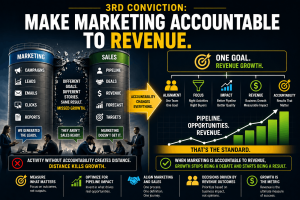
It allows marketing to succeed without necessarily influencing revenue. It allows revenue to suffer without clearly identifying where the breakdown occurred.
Over time, this creates distance between teams that should be tightly aligned. Marketing becomes focused on proving activity. Sales becomes focused on recovering from gaps in quality or volume. Leadership is left trying to interpret two different narratives about the same growth story.
The result is predictable.
Marketing becomes defensive.
Sales becomes skeptical.
And conversations shift from growth to justification.
The longer I worked in B2B organizations, the clearer this pattern became. The teams that created the most consistent growth were not necessarily the ones with the most activity or the most polished reporting. They were the ones where marketing accepted direct responsibility for pipeline contribution.
When that happens, the nature of decision-making changes immediately.
Marketing stops asking how to improve reporting and starts asking how to improve outcomes. Campaigns are no longer judged by engagement alone, but by their impact on opportunities. Budget decisions are evaluated through the lens of revenue contribution rather than activity volume.
This shift is not cosmetic. It changes behavior at every level of the organization.
My own thinking evolved through this same progression. With every role I took on, the expectation moved closer to revenue. The further I moved into leadership, the less patience there was for explanations that did not connect directly to business outcomes.
That progression shaped my Fractional CMO perspective more than anything else.
In a fractional model, there is no separation between marketing effort and business result. There is no buffer of internal reporting layers. There is no opportunity to rely on activity as proof of work. The only meaningful question is whether marketing is contributing to growth.
If marketing contributes to growth, the value becomes obvious. If it does not, the gap becomes equally visible.
That clarity is uncomfortable for some organizations. But it is also where the real work begins.
Because once marketing is accountable to revenue, everything becomes simpler.
Priorities become clearer. Trade-offs become easier. Focus improves.
And the organization stops debating activity and starts improving outcomes.
Marketing should not sit beside revenue. It should be accountable for contributing to it.
Full stop.
What This Means for B2B Founders and CXOs
If you are a founder or CXO reading this, the question is not whether these convictions are correct.
The question is whether your organization is actually operating by them.
Because in most B2B companies, there is a gap between what leaders believe marketing should do and what marketing is structurally set up to do. Marketing is expected to contribute to growth, yet it is often measured using metrics that have little direct connection to revenue. Teams become busy. Activity increases. Reports improve. But the business still struggles to build predictable growth.
That gap has a cost.

When marketing is not accountable to the pipeline, every quarter starts to feel disconnected from the last. Teams work hard, but the organization does not necessarily comprehend. Activity continues, yet predictability remains unchanged. Growth becomes harder to explain and even harder to forecast.
When marketing does not compound, every new quarter effectively becomes year one. More campaigns are needed. More budget is required. More effort is invested simply to maintain momentum. That model can work for a while, especially during periods of early-stage growth. Over time, however, it becomes increasingly inefficient. The organization spends more energy sustaining activity than building leverage.
The cost becomes even more visible at the leadership level.
When marketing cannot clearly connect its work to pipeline, conversations with boards and investors become defensive. Marketing is forced to explain performance in terms of activity rather than outcomes. Confidence in the function weakens, even when effort levels remain high.
The alternative is alignment.
When marketing is directly accountable to pipeline and revenue contribution, the entire system changes. Planning becomes more focused. Execution becomes more disciplined. Sales and marketing begin operating from a shared definition of success. Leadership gains a clearer view of how growth is actually being created.
The most important shift, however, is compounding.
Once marketing is designed around outcomes rather than activity, it stops resetting every quarter. Systems begin to carry forward value. Assets begin to accumulate impact. And growth becomes more predictable over time.
That is the real opportunity.
Not better campaigns.
Not better reporting.
But a marketing function that compounds.
This is what twenty years in B2B marketing has taught me.
The posts in this series are where I unpack it – argument by argument, conviction by conviction.
Posts in This Series
-
From SEO Executive to SVP: What 20 Years in B2B Marketing Actually Teaches You
The lessons, patterns, and realities that only emerge after two decades of building pipelines and leading marketing teams.
-
Why I Left a 13-Year Corporate Career to Go Independent – And What I Know Now
What drove my transition from corporate leadership to independent consulting and what that journey taught me about growth and accountability.
-
The Conviction That Runs Through Everything I Do: Marketing Must Be Accountable to Revenue
Why revenue accountability became the foundation of my approach to marketing leadership and decision-making.
-
Most B2B Marketing Fails for the Same Reason. I Have Seen It Too Many Times to Stay Quiet.
The recurring mistake I have observed across organizations and the hidden cost it creates.
-
What the $40M Pipeline Story Is Really About – It Is Not the Number.
Why the most important lesson from building a $40M+ pipeline has nothing to do with the number itself.
-
The B2B Marketing Industry Has an Honesty Problem. Here Is What Nobody Is Saying.
A candid perspective on the narratives, metrics, and assumptions that continue to mislead marketing teams.
-
Why I Wrote CITED BY AI – And What I Hope B2B Leaders Take From It.
The thinking behind the book and why AI-driven search is forcing a rethink of digital visibility.
-
Awards, Accolades, and Industry Recognition – What They Mean and What They Don’t.
A perspective on recognition, credibility, and the difference between reputation and results.
-
The Question Every B2B Founder Should Ask Their Marketing Leader – And Almost None Do.
The one question that reveals whether marketing is truly contributing to growth or simply generating activity.
Final Thoughts
This page is not a summary of my career.
It is a summary of the convictions that survived it.
Everything I have learned over two decades of building demand, creating pipeline, and leading marketing teams comes back to three ideas: digital marketing should build pipeline, systems outperform campaigns, and marketing must be accountable to revenue.
The articles in this series explore those convictions in greater depth. Each one examines a specific lesson, pattern, or argument that shaped the way I think about growth and what separates marketing activity from marketing impact.
If these ideas resonate with you, the best place to continue is with the first article in the series, where I unpack the experiences, lessons, and patterns that shaped these convictions.
Start with the first post in the series >>>> From SEO Executive to SVP: What 20 Years in B2B Marketing Actually Teaches You
And if you would rather talk about your own situation, that’s an option too. If you’re trying to create a more predictable pipeline, align marketing with revenue, or build a marketing system that compounds over time, I’d be happy to have that conversation.
If you’d rather talk about your pipelines, let’s do that >>>> Contact Page